
How to start exercising quietly at home without equipment
How do you start exercising at home with zero equipment when gyms feel intimidating, downstairs neighbors rule out jumping, and weight-loss apps turn every workout into a body critique? All you need is a clear strip of rug or mat about one body-length long (or an empty patch of wall if you prefer staying upright), combined with slow three-second lowering phases and 20 to 30 second isometric holds that challenge muscles quietly.
Creating real strength stimulus without dumbbells, bands, or jumping
Many home routines equate zero equipment with frantic high-impact cardio such as burpees, jump squats, and mountain climbers. High-impact circuits are loud, jar sensitive knees and wrists, and leave beginners out of breath long before their muscles get a calm strength signal.
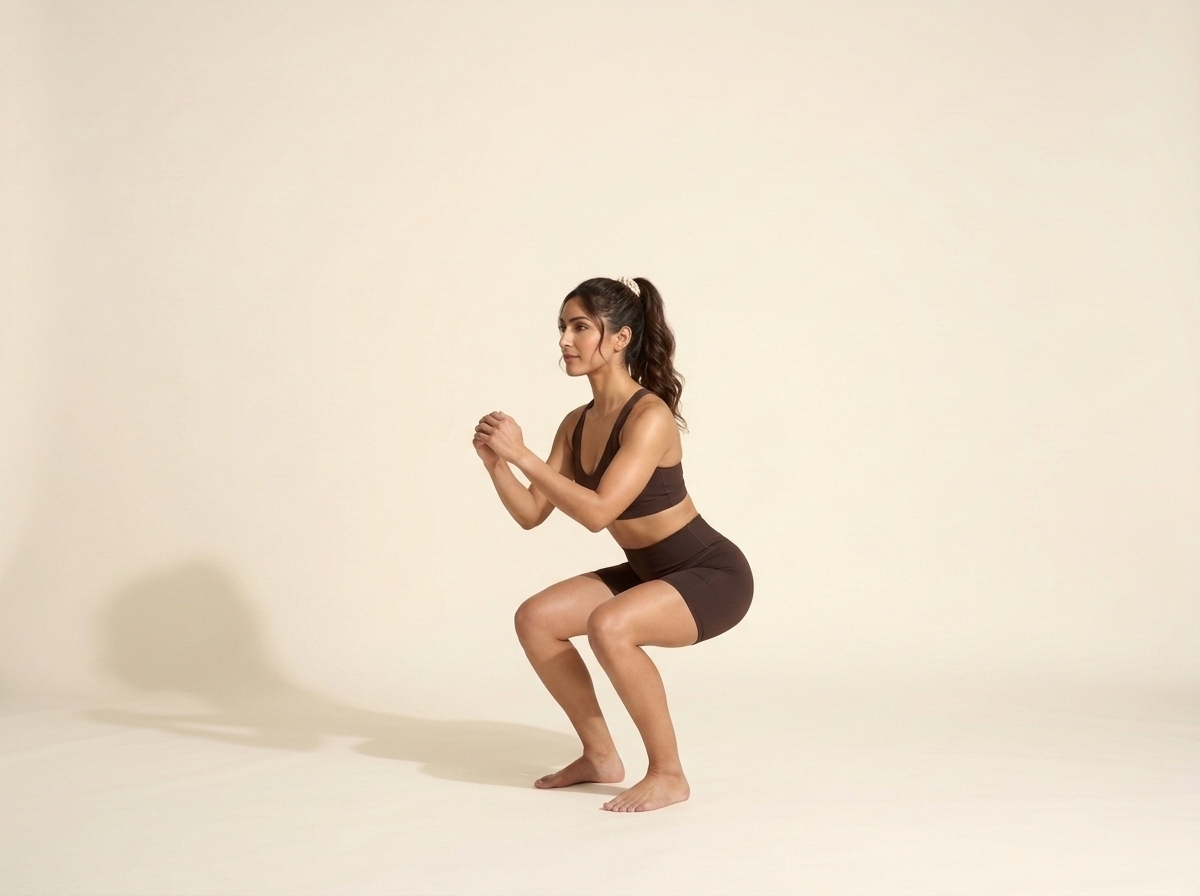
Classical mat Pilates and controlled bodyweight training create resistance differently: through leverage, slow tempo, and pauses at peak contraction. Holding the top of a glute bridge for 25 seconds, sitting against a wall at a comfortable knee angle for 25 seconds, rising onto the balls of your feet for two slow counts in a calf raise, or pressing your forearms into a standing wall plank works your legs, glutes, and trunk in complete silence.
Measuring your starting point by how a move feels rather than a scale
Stepping onto a bathroom scale or entering calorie targets tells you nothing about whether eight slow glute bridges feel comfortable on your lower back or whether you would rather stay off the floor today. Starting with one honest movement check — watching a calm demonstration of a glute bridge and picking whether eight repetitions would feel easy, manageable with a rest, hard right now, or better replaced with standing moves — sets realistic targets from day one without any body measurements.
Removing daily friction so you actually begin
The hardest moment of an unseen home workout is the two minutes before you start. Leaving a big video catalog open forces you to pick a duration, filter out equipment you do not own, preview whether the instructor moves too fast, and hope no surprise lunges show up halfway through. Having today's 10 to 20 minute list already picked out — with one-tap swaps if a joint feels tender and a stepper down to 5 minutes on exhausting days — turns starting into pressing a single button in whatever clothes you are already wearing.
Cost and features check: SeeMeFit gives you a decided 10 to 20 minute equipment-free home plan across 40 floor, standing, and wall moves — with upfront pricing shown before the quiz, zero weight or calorie tracking, unlimited move swaps, rest-day streak credit, and optional on-device side-on counting — for $9.99 a year or $1.99 a month after a 7-day free trial (checked November 16, 2026). That compares with $49.99 a year on Tone AI, $29.99 a year on Workout for Women and BetterMe, and $134.99 a year on Sweat (checked November 8–10, 2026), while providing saved history, enforced joint exclusions, looping studio demonstrations, and on-device counting that a free ChatGPT text prompt cannot supply.